

Cute Killers: 16 Unassuming-but-Lethal Poison Plant
Most plants contain some level of toxins (like alkaloids) for defense. After all, they?re plants. They can?t go anywhere. Through millennia of trial and error, both animals and human beings have figured out which plants are safe, which are lethal, and which are somewhere in between. For example, did you know that many grain-bearing plants contain a toxin known as lectins? And that the African staple, cassava, must be thoroughly boiled and soaked to separate it from its poisonous compound, cyanide? Even the humble lima bean has been bred to contain less cyanide. Cherries, potatoes, peaches and apple seeds are all toxic ? eat enough of the latter, in fact, and it will prove fatal. Fortunately, artificial selection and cooking methods have all but eliminated the threat of toxins in everyday foods. But you may be surprised to find out the incredibly lethal plants often hanging around the neighborhood park ? or gracing your tabletop in the form of a centerpiece.
Castor Bean

Images via UCC, My Sunshine Garden and remarc
Castor oil ? for anyone unlucky enough to have been force spoon-fed this healthy yet disgusting fluid as a child, you may be surprised to learn that an ingredient in the castor bean just happens to be the deadliest plant poison on earth. Literally. Just one tiny castor bean is enough to kill an adult within a few minutes. Castor oil is made safe (but not palatable) with the removable of the lethal compound known as ricin. Amazingly, castor bean plants are grown for decorative purpose all over the place, particularly in California.
Rosary Pea

Image source unknown
As if a deadly legume weren?t bad enough, the pulses aren?t so benign, either. The rosary pea may sound sweet and downright pious, but it?s actually one of the most dangerous plants on earth. Its seeds contain a particular lectin known as abrin; if chewed and swallowed, death will follow shortly. The seeds are easily identified with their distinctive bright red jacket and single black dot (almost like a reverse Black Widow spider). Abrin, which does its damage by inactivating ribosomes, is one of the most fatal toxins on earth. After the vomiting, fever, nausea, drooling and G.I. dysfunction but before the bizarre hyperexcitability, edema and fatally convulsive seizures, renal tubular degeneration, bladder and retinal hemorrhage and widespread internal lesions typically develop.
Monkshood

Image via About.com
Another unassuming plant ? until you learn that the nickname for monkshood is actually ?wolfsbane?. That?s owing to its once common use by farmers as a very effective wolf extermination tool. (Not to be left out, fowl are also fatally affected by the related hensbane.) The monkshood has the distinction of evidently being the bane of many creatures: its nicknames include womensbane and leopard?s bane, though it is also known as blue rocket and devil?s helmet. It is technically part of the aconitum genus, of which there are more than 250 species. The wolfsbane used to be a popular werewolf detection tool, by the way. (Status was determined by holding the flower near the alleged?s chin; a yellow-tinged shadow on the skin was thought to be confirmation.)
Bushman?s poison

Images via plantzafrica
The aptly-named Bushman?s poison has famously been used by the Khoisan of South Africa to poison the tips of their arrows. Though the plant produces pleasantly scented flowers and a tasty plum-like berry, the milky sap can be fatal. The leaves, however, have medicinal properties. Bushman?s poison is also known as thewintersweet.
Angel?s trumpet

Images via Direct Gardening and Wikimedia
What could be sweeter than the sound of an angel?s trumpet? Perhaps the moaning agony of a trip that won?t end. Related to petunias, tomatoes and potatoes, the angel?s trumpet (datura stramonium) is a highly effective hallucinogen, but should not be consumed for recreational purposes as it can also be lethal. According to wikipedia: ?The active ingredients are atropine, hyoscyamine andscopolamine which are classified as deliriants, or anticholinergics. Due to the elevated risk of overdose in uninformed users, many hospitalizations, and some deaths, are reported from recreational use.? This common plant also goes by many other names, including jimson weed, stink weed, loco weed, and devil?s snare. One 18-year-old who was house-sitting alone for his uncle recounts how he decided to prepare some angel?s trumpet tea in curiosity and almost died (a friend burst in on him convulsing on the bathroom floor and the authorities assumed he was on an acid trip).
Water hemlock

Image via Rutgers
The poison hemlock famously drunk by Socrates is deadly, but thewater hemlock is just as fatal. According to the USDA, water hemlock or poison parsnip is ?the most violently toxic plant in North America?. The flowers and stems are safe, but the stalky roots contain chambers that are full of a deadly sap containing the convulsant cicutoxin. Grand mal seizures are followed by a quick death if even a tiny amount is consumed.
English Yew

Images via greenlover, c-r-alpacas, bomengids, and Britannica
The English Yew, or taxus baccata (?taxus? meaning toxin), is one of the deadliest trees on the planet. The evergreen has a majestic and lush appearance and is fairly common in forests of Europe. The yew is considered by scientists to be an odd and primitive conifer along with the monkey puzzle tree of Chile and Gingko biloba tree of Asia. The yew has a rather sad history. All parts ? save for the flesh of the berries ? are extremely poisonous. Because the toxin causes convulsions and paralysis, it was once used as an abortifacient. Apothecaries would dry and powder the leaves and stems and give desperate women minute amounts in the days before birth control was available. Unfortunately, death would often result. The yew has been quite popular throughout history for a number of medicinal purposes at extremely dilute levels, but it is deemed too dangerous in modern medical practice to be of use. The yew?s primary toxin is taxine, a cardiac depressant. The yew acts rapidly and there is no antidote.
Snakeroot
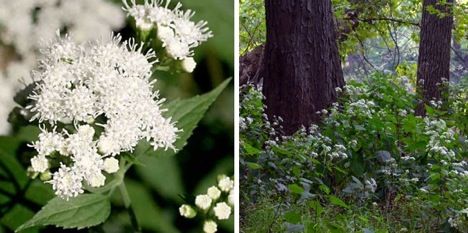
Images via Sonja Keohane and canalphotos
Snakeroot is most dangerous for livestock such as cattle and sheep. When cows consume the attractive fluffy white blooms and stems of the snakeroot, their milk and bones become saturated with the toxin tremetol and humans who consume these contaminated animal products will develop milk sickness (tremetol poisoning). In fact, milk sickness is what killed Abraham Lincoln?s mother, Nancy Hanks.
Strychnine tree

Images via motherherbs, BRAIN and wikipedia
Queen Cleopatra famously forced servants to commit suicide by means of a strychnine tree?s fruit seeds, which contain lethal levels ofstrychnine and brucine, in order to determine if it would be the best means for her own suicide. Upon seeing their agony (which included painful vomiting, facial contortions and convulsions) she opted for the apparently less horrific choice of the asp. (The asp was actually an ancient term for any number of poisonous snakes, but experts think it was probably the cobra that Cleopatra chose to end her life.)
Moonseed

Images via Missouri plants and paradisegardentx
A otherworldly name and a plant with often fatal effects. The seeds of this Eastern North American drupe (stone fruit) are extremely toxic to humans, although birds can eat them. Moonseeds first cause paralysis but are fatal in larger doses and/or if treatment is not sought immediately.
Daphne
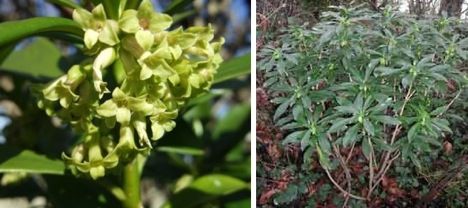
Images via Bonnie Day and Island Net
This plant, also called the spurge laurel, is a favorite ornamental shrub in Europe. This drupe-producing evergreen with waxy, attractive foliage and gorgeously fragrant blooms is also highly toxic. Consumption of the leaves or red or yellow fruits will first cause nausea and violent vomiting, followed by internal bleeding, coma and death. The daphne plant is rich in the toxin mezerein.
Narcissus
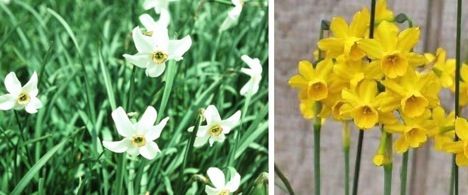
Images via the Guardian and the flower expert
Narcissists are toxic enough when they come in human form, but the plant for which they are named, also called the daffodil, is highly poisonous. Poet?s narcissus is more toxic than daffodil, but in both cases it is the bulbs, not the flower or stems, that cause illness. One famous fatal case in Toulouse in the early 1900s occurred when the bulbs were mistaken for onions and consumed. According toBotanical.com, ?Socrates called this plant the ?Chaplet of the infernal Gods,? because of its narcotic effects. An extract of the bulbs, when applied to open wounds, has produced staggering, numbness of the whole nervous system and paralysis of the heart.? Yet, there are medicinal properties, and some cultures even believe they can cure baldness and serve as a potent aphrodisiac. (Do not try at home.)
Oleander

Image via Bay Area Hiker
The oleander is the most deadly plant in the world. It is also tremendously popular as a decorative shrub. Just one leaf can kill an adult, and fatal poisonings have resulted from minimal exposure to the twigs, blooms and berries. The plant contains numerous toxins, including nerioside, oleandroside, saponins, and cardiac glycosides. Though native to parts of the Mediterranean and Asia, it is now widely cultivated throughout the world. Fatalities among horses and other livestock are common. Once ingested, oleander goes to work simultaneously on the nervous system, the cardiovascular system, and the digestive tract.
Rhododendron

Images via SOUL, Netstate and Kew
The toxic rhododendron, a stalky tree-like evergreen shrub with large, brilliant blooms, is famously seen throughout much of the Pacific Northwest and is the state flower of Washington. Its relative, the popular garden shrub azalea, is also poisonous. Both plants contain andromedatoxin, which can cause severe pain, lethargy, depression, vomiting and nausea, progressive paralysis, coma and eventual death. All parts are deadly.
Choke cherry

Images via Why Oh Why and BC
Chokecherry, or wild cherry, is a North American plant that is known for its large sprays of tiny white flowers. The cherries are small and not eaten. The plant?s woody stalks and leaves are full of hydrocyanic acid, which is fatal if consumed. The poison affects the respiratory system, and rapid breathing, choking and asphyxiation result.
Nightshade

Image via PBase
Also known as the devil?s cherry, black cherry, great morel and belladonna, the nightshade is toxic from tip to top. Containing atropine, a deadly alkaloid, those who ingest even a small amount of the plant will soon notice they have lost their voice. Respiratory trouble and convulsions follow. The plant is problematic because its cherries are so sweet and children are frequently attracted to the wild fruit. Strangely, horses, birds, sheep, goats and pigs seem to be immune to the effects of nightshade. Nightshade poisoning is treatable with an emetic if treatment is sought swiftly. Plutarch spoke of armies being wiped out by nightshade, and legend has it that Macbeth?s soldiers poisoned the invading Danes with wine made from the sweet fruit.
There are many, many more toxic plants, but these plants were chosen for inclusion in this post due to their their incredible characteristics.