

The world is filled with ancient monuments built by master craftsmen in order to honor everything from kings and presidents to religious figures. And although most of these landmarks have been carefully studied and researched by scientists and historians, some are simply so old, incomplete, or obscure that we still dont know very much about why they were built or what purpose they served. The following are 10 world landmarks that, whether by intention or simply due to the passage of time, continue to baffle the people who study them.
10. The Cahokia Mounds

Cahokia is the name given to an Indian settlement that exists outside of Collinsville , Illinois . Archeologists estimate that the city was founded sometime around 650 AD, and its complex network of burial grounds and sophisticated landscaping prove that it was once a thriving community. It has been estimated that at its peak the city was home to as many as 40,000 people, which would have made it the most populous settlement in America prior to the arrival of the Europeans. The most notable aspect of Cahokia today are the 80 mounds of earth, some as high as 100 feet, which dot the 2,200-acre site. These helped create a network of plazas throughout the city, and it is believed that important buildings, like the home of the settlements chief, were built on top of them. The site also features a series of wooden posts that archeologists have dubbed woodhenge. The posts are said to mark the solstices and equinoxes, and supposedly figured prominently in the communitys astronomical mythology.
The Mystery
Although scientists are constantly discovering new information about the Cohokia community, the biggest mystery that remains is which modern Indian tribe is descended from the residents of the ancient city, as well as just what it was that caused them to abandon their settlement.
9. Newgrange

Considered to be the oldest and most famous prehistoric site in all of Ireland , Newgrange is a tomb that was built from earth, wood, clay, and stone around 3100 BC, some 1000 years before the construction of the pyramids in Egypt . It consists of a long passage that leads to a cross-shaped chamber that was apparently used as a tomb, as it contains stone basins filled with cremated remains. The most unique feature of Newgrange is its careful and sturdy design, which has helped the structure remain completely waterproof to this day. Most amazing of all, the entrance to the tomb was positioned relative to the sun in such a way that on the winter solstice, the shortest day of the year, the rays from the sun are channeled through the opening and down the nearly 60 foot passageway, where they illuminate the floor of the monuments central room.
The Mystery
Archeologists know Newgrange was used as a tomb, but why and for who still remains a mystery. The painstaking design needed to guarantee that the yearly solstice event occurs suggests that the site was held in high regard, but other than the obvious hypothesis that the sun featured prominently in the mythology of the builders, scientists are at a loss to describe the true reason for Newgranges construction.
8. The Yonaguni Monument

Of all the famous monuments in Japan , perhaps none is more perplexing than Yonaguni, an underwater rock formation that lies off the coast of the Ryuku Islands . It was discovered in 1987 by a group of divers who were there to observe Hammerhead sharks, and it immediately sparked a huge amount of debate in the Japanese scientific community. The monument is made up of a series of striking rock formations including massive platforms, carved steps, and huge stone pillars that lie at depths of 5-40 meters. There is a triangular formation that has become known as the turtle for its unique shape, as well as a long, straight wall that borders one of the larger platforms. The currents in the area are known for being particularly treacherous, but this has not stopped the Yonaguni monument from becoming one of the most popular diving locations in all of Japan .
The Mystery
The ongoing debate surrounding Yonaguni centers on one key subject: is the monument a natural phenomenon, or is it man-made? Scientists have long argued that millennia of strong currents and erosion have carved the formations out of the ocean floor, and they point to the fact that the monument is all one piece of solid rock as proof that it was not assembled by a builder. Others, though, point to the many straight edges, square corners and 90-degree angles of the formation as proof that its artificial. They often cite one formation in particular, a section of rock that resembles a crude carving of a human face, as evidence. If they are right, then an even more interesting mystery presents itself: who constructed the Yonaguni Monument , and for what purpose?
7. The Nazca Lines

The Nazca lines are a series of designs and pictographs carved into the ground in the Nazca Desert , a dry plateau located in Peru . They cover an area of some 50 miles, and were supposedly created between 200 BC and 700 AD by the Nazca Indians, who designed them by scraping away the copper colored rocks of the desert floor to expose the lighter-colored earth beneath. The lines have managed to remain intact for hundreds of years thanks to the regions arid climate, which sees it receive little rain or wind throughout the year. Some of the lines span distances of 600 feet, and they depict everything from simple designs and shapes to characterizations of plants, insects, and animals.
The Mystery
Scientists know who made the Nazca Lines and how they did it, but they still dont know why. The most popular and reasonable hypothesis is that the lines must have figured in the Nazca peoples religious beliefs, and that they made the designs as offerings to the gods, who would ve been able to see them from the heavens. Still, other scientists argue that the lines are evidence of massive looms that the Nazcas used to make textiles, and one investigator has even made the preposterous claim that they are the remnants of ancient airfields used by a vanished, technologically advanced society.
6. Goseck Circle

One of the most mysterious landmarks in Germany is the Goseck Circle , a monument made out of earth, gravel, and wooden palisades that is regarded as the earliest example of a primitive ?solar observatory. The circle consists of a series of circular ditches surrounded by palisade walls (which have since been reconstructed) that house a raised mound of dirt in the center. The palisades have three openings, or gates, that point southeast, southwest, and north. It is believed that the monument was built around 4900 BC by Neolithic peoples, and that the three openings correspond to the direction from which the sun rises on the winter solstice.
The Mystery
The monuments careful construction has led many scientists to believe that the Goseck Circle was built to serve as some kind of primitive solar or lunar calendar, but its exact use is still a source of debate. Evidence has shown that a so-called ?solar cult was widespread in ancient Europe . This has led to speculation that the Circle was used in some kind of ritual, perhaps even in conjunction with human sacrifice. This hypothesis has yet to be proven, but archeologists have uncovered several human bones, including a headless skeleton, just outside the palisade walls.
5. Sacsayhuaman

Not far from the famous Inca city of Machu Picchu lies Sacsayhuaman, a strange embankment of stone walls located just outside of Cuzco . The series of three walls was assembled from massive 200-ton blocks of rock and limestone, and they are arranged in a zigzag pattern along the hillside. The longest is roughly 1000 feet in length and each stands some fifteen feet tall. The monument is in astonishingly good condition for its age, especially considering the regions propensity for earthquakes, but the tops of the walls are somewhat demolished, as the monument was plundered by the Spanish to build churches in Cuzco . The area surrounding the monument has been found to be the source of several underground catacombs called chincanas, which were supposedly used as connecting passageways to other Inca structures in the area.
The Mystery
Most scientists agree that Sacsayhuaman served as a kind of fortress of barrier wall, but this has been disputed. The strange shape and angles of the wall have led some speculate that it may have had a more symbolic function, one example being that the wall, when seen next to Cuzco from above, forms the shape of the head of a Cougar. Even more mysterious than the monuments use, though, are the methods that were used in its construction. Like most Inca stone works, Sacsayhuaman was built with large stones that fit together so perfectly that not even a sheet of paper can be placed in the gaps between them. Just how the Incas managed such expert placements, or, for that matter, how they managed to transport and lift the heavy hunks of stone, is still not fully known.
4. The Easter Island Moai
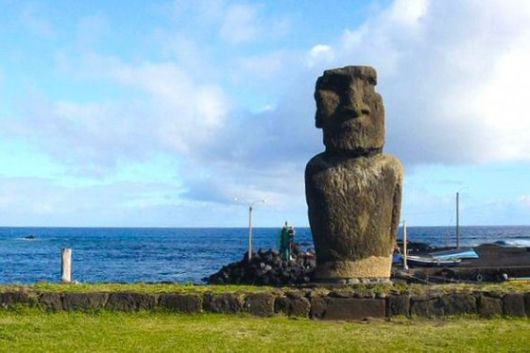
One of the most iconic series of monuments in the Pacific islands is the Moai, a group of huge statues of exaggerated human figures that are found only on the small, isolated island of Rapa Nui , or Easter Island . The Moai were carved sometime between 1250 and 1500 AD by the islands earliest inhabitants, and are believed to depict the peoples ancestors, who in their culture were held in the same regard as deities. The Moai were chiseled and carved from tuff, a volcanic rock that is prevalent on the island, and they all feature the same characteristics of an oversized head, broad nose, and a mysterious, indecipherable facial expression. Scientists have determined that as many as 887 of the statues were originally carved, but years of infighting among the islands clans led to many being destroyed. Today, only 394 are still standing, the largest of which is 30 feet tall and weighs over 70 tons.
The Mystery
While there is a fairly solid consensus on why the Moai were erected, how the islanders did it is still up for debate. The average Moai weighs several tons, and for years scientists were at a loss to describe how the monuments were transported from Rano Raraku, where most of them were constructed, to their various locations around the island. In recent years, the most popular theory is that the builders used wooden sleds and log rollers to move the Moai, an answer that would also explain how the once verdant island became almost totally barren due to deforestation.
3. The Georgia Guidestones

While most of the mysterious monuments on this list only became that way as centuries passed, the Georgia Guidestones, also known as American Stonehenge, are one landmark that was always intended to be an enigma. The monument, which consists of four monolithic slabs of granite that support a single capstone, was commissioned in 1979 by a man who went by the pseudonym of R.C. Christian. A local mason carefully crafted it so that one slot in the stones is aligned with the sun on the solstices and equinoxes, and one small hole is always pointed in the direction of the North Star. Most interesting, though, are the inscriptions on the slabs, which an accompanying plaque describes as ?the guidestones to an Age of Reason. In eight different languages, the slabs offer a strange ten-point plan to ensure peace on Earth that includes vague proclamations like ?prize truth?beauty?love?seeking harmony with the infinite, to very specific commands like ?maintain humanity under 500,000,000 in perpetual balance with nature. Comments like this one have made the Guidestones one of the most controversial landmarks in the United States, and they have long been protested and even vandalized by groups that would like to see them demolished.
The Mystery
For all their controversy, very little is known about who built the Guidestones or what their true purpose is. R.C. Christian claimed he represented an independent organization when he commissioned the landmark, but neither he nor his group has spoken up since its construction. Since the monument was built during the height of the Cold War, one popular theory about the groups intentions is that the Guidestones were to serve as a primer for how to rebuild society in the aftermath of a nuclear holocaust.
2. The Great Sphinx of Giza

Sphinxes are massive stone statues that depict the body of a reclining lion with the head and face of a human. The figures are found all over the world in different forms, but they are most commonly linked with Egypt , which features the most famous example in the form of the Great Sphinx of Giza. Incredibly, the statue is carved out of one monolithic piece of rock, and at 240 feet long, 20 feet wide, and 66 feet tall, it is considered to be the biggest monument of its kind in the world. Historians largely accept the function of the Sphinx to have been that of a symbolic guardian, since the statues were strategically placed around important structures like temples, tombs, and pyramids. The Great Sphinx of Giza appears to be no different. It stands adjacent to the pyramid of the pharaoh Khafra, and most archeologists believe that it is his face that is depicted on that of the statue.
The Mystery
Despite its reputation as one of the most famous monuments of antiquity, there is still very little known about the Great Sphinx of Giza. Egyptologists might have a small understanding of why the statue was built, but when, how, and by who is still shrouded in mystery. The pharaoh Khafra is the main suspect, which would date the structure back to around 2500 BC, but other scientists have argued that evidence of water erosion of the statue suggests that it is much older and perhaps even predated the dynastic era of the Egyptians. This theory has few modern adherents, but if true it would mean the Great Sphinx of Giza is even more mysterious than previously believed.
1. Stonehenge

Of all the worlds famous monuments, none has gained as much of a reputation for pure, simple mystery as Stonehenge . Stonehenge has been inspiring debate among scholars, scientists, and historians since the Middle Ages. Located in the English countryside, the landmark is believed to date back to 2500 BC, and consists of several mammoth pieces of rock arranged and piled on top of one another in what appears at first to be a random design. The site is surrounded by a small, circular ditch, and is flanked by burial mounds on all sides. Although the rock formations that still remain are undoubtedly impressive, it is thought that the modern version of Stonehenge is only a small remnant of a much larger monument that was damaged with the passing of time, and it is largely believed that the building process was so extensive that it could have lasted on and off for anywhere from 1500 to 7000 years.
The Mystery
Stonehenge has become renowned for puzzling even the most brilliant researchers, and over the years the many gaps in the history of its construction, the nature of its use, and the true identity of its builders have become known as The Mystery of Stonehenge. The Neolithic people who built the monument left behind no written records, so scientists can only base their theories on the meager evidence that exists at the site. This has led to wild speculation that the monument was left by aliens, or that it was built by some eons-old society of technologically advanced super-humans. All craziness aside, the most common explanation remains that Stonehenge served as some kind of graveyard monument that played a role in the builders version of the afterlife, a claim that is backed up by its proximity to several hundred burial mounds. Yet another theory suggests that the site was a place for spiritual healing and the worship of long dead ancestors.